Showing posts with label lace. Show all posts

Sunday, November 7, 2010

Knitted text: why & how, plus inspiration

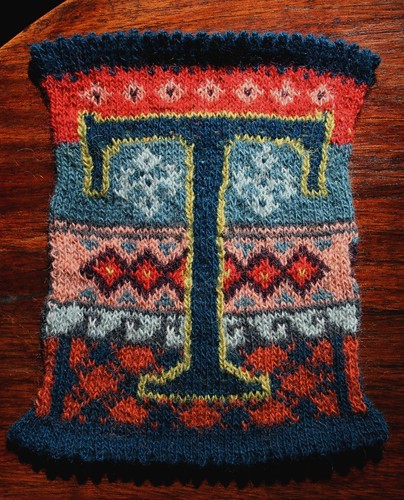
Knitted text can be beautiful as well as meaningful, as you’ll see if you explore Susette Newberry’s knitted abecedarium on Flickr. Don’t miss her blog, Knitting Letters: A to Z, a wonderful compendium of knitting tradition and history with a typographic twist. Here’s her Turkish “T”:

IMG_4864

We ordinary knitters might like to use much smaller letters than this one to knit a loved one’s name or a secret message into a Christmas stocking or the hem of a sweater.  Or, how about knitting a favorite quote into a mitten or sock? If you’re like me, the difficulty of charting a phrase, much less a poem, means not even trying.

I’ve recently come across two great resources for charting letters for knitted colorwork. First of all, there’s Chemknits’ assembly of alphabet charts. This post lists links to more than 40 charted alphabets – lots of different letter styles and sizes, plus Hebrew and Greek letters.

WinRKA is a simple freeware application that will chart a name, word, phrase, or a whole message or poem for you. You specify your own stitch and row gauges, how many blank lines you want between lines of text, how many blank stitches between letters, and so on – then type in your message, and voilà –WinRKA generates a printable chart for you. No font choices; letters are sans serif capitals – but you can choose font width. You can specify centered, right- or left-justified, or fully justified text, and numerals and basic punctuation marks and symbols are available as well (period, comma, question mark, quotes, etc.). For Windows only (95, 98, ME, 2000, XP); no Mac version. Download WinRKA here.

Patterns and projects for textual inspiration

Lynny’s Dale sweater, knitted for her firefighter son, has the message “from heaven to the gates of hell and back to heaven again,” plus his name and the date, inside the hem.


Susette Newberry’s P Chullo hat pattern is a free Ravelry download, designed for her P is for Peru abecedarium post. The pattern has a full alphabet chart so you can knit your own message into the hat, as Susette did, plus a second chart for triangular initials for the earflaps:

Chullo1

You’ll find several glove, mitten and sock patterns on Ravelry that feature knitted-in poems or other quotations:

text-2

Left: Nanette Blanchard’s Bewitching Gloves, with the witches’ chorus from Shakespeare’s MacBeth on the gauntlet. Center: The Poetry Mittens were designed to accompany a Piecework article on the 18th- and 19th-century tradition of poetry on mittens; the poem goes

"When snow swirls
We begin to dream
Of dancing firelight
And hasten gaily home
Clapping hands
And words to
Warm them. "

On the right, the Pearls of Wisdom socks appeared in Socks, Socks, Socks from XRX Books (1998). They feature the last few lines of Pablo Neruda’s poem, “Ode to My Socks” in the original Spanish (English translation by Robert Bly; or listen to Neruda read the poem). The pattern is not available online, but the book can often be found in libraries, or you could reverse-engineer them.

Two wintry patterns:

text-1

On the I Heard the Bells mittens: the first stanza of Longfellow’s “Christmas Bells,” familiar as a carol. Christmas stockings often have names or messages knitted into them – above, the Peace stocking. Patterns usually include alphabet charts so you can choose your message or name.

Perhaps you’ve got a political opinion to express, as all three of these free patterns do:

text-4

With a creative combination of stranded knitting and intarsia, Laura Chamberlain’s Inspiration scarf reproduces this quote from an 2008 Obama campaign speech:

“When we’ve faced down impossible odds: Been told that we’re not ready, or that we shouldn’t try, or that we can’t, generations of Americans have responded with a simple creed that sums up the spirit of a people… YES WE CAN!!”

The short version - Jaala Spiro’s Yes We Can Hat. And at right, Lisa Anne Auerbach’s Body Count Mittens are designed to memorialize war casualties – the dates and numbers will vary, depending on when you knit them. See more of Auerbach’s work here.

Of course, you needn’t knit in English or another Western language. The sock patterns below both feature the Arabic word for “blessing”:

baraka-socks

Miriam Felton’s Blessing socks – Baraka/Blessing socks from Dar Anahita. This would be a nice sentiment for a baby hat or sweater, too. Find charts for Arabic letters, inscriptions and Quran verses at Islamic and Arabic Cross-stitch and Islamic Cross Stitch Patterns.

I haven’t been able to find good sources for charted Chinese or Japanese Kanji characters. Here are just a few charts I came across – let me know if you find anything else:

Patterns featuring kanji on Ravelry
Kanji charts for Chinese birth years (from Knitty tabi sock pattern)
Patterns featuring Chinese characters on Ravelry

Writing in lace

Finally, if lace is your preferred medium, Bridget Rorem’s Lace Alphabets Scarf Sampler (available from Schoolhouse Press) has two alphabets you can use to knit messages into any lace project.


Rorem’s Near Solstice Shawl, for instance, has an original haiku knitted along the top edge (unfortunately I can’t find a better photo).

Have you knitted a message or statement into a project? If you have a good photo, please comment and give us a link!

Thursday, September 16, 2010

Pattern roundup: fingerless mitts, lace edition

Our fingerless mitt pattern series continues today with mitts featuring lace.
Why fingerless mitts? See the first post in the series.

Photos below are Ravelry screen shots, so scroll down for live links.
 mitts-lace1
Above, top row:  Cafe au lait, Veyla, Bronte’s Mitts. Bottom row: Snow on Cedars, Verdigris, Della Mitts.
mitts-lace2 Above, top row: Wine and Roses, Belladonna, Spiralling Leaves. Bottom row: 1965 Arm Warmers, Wild Growth (there are fingering and Aran-weight versions of this pattern), Barberry Mitts.
mitts-lace-4 Above, top row: Easy Lace Fingerless Mitts, Hand Springs, Riblitts. Bottom row: BonBons, Arctic Blast, Betsyanna.
mitts-lace3
And finally – Elin, Constance Spry, and the brand-new Maia Fingerless Mitts.


For fellowship and inspiration, join the Fingerless Glove Fanatics on Ravelry
Click here to browse all 1,400+ free fingerless mitt patterns on Ravelry

Coming Saturday: Plain & simple mitts, plus some overlooked gems

Series:
Part 1 – textured mitts
Part 2 – colorful mitts

Thursday, May 27, 2010

The Perennial Question

Can she do it?

miralda-wip

49 rows to go on Miralda’s Triangular Shawl. It doesn’t look promising, even though they get shorter and shorter. If I run out, here’s my option:

P1400036

I’m knitting with my handspun for the first time, and that there is the remains (appropriate word) left on the second bobbin after plying all of the first one. I wound it off into a ball thinking I’d ply the rest of it from the two ball ends, but that didn’t go well – you can see why! “Energized” would be a kind word here.

(Furthermore, when I went over to the Ravelry pattern page to get the link for this post, I saw the errata for the first time. I wondered about that bit of asymmetry in the nupp diamond chart, but didn’t wonder hard enough to go looking for corrections.)

Wish me luck.

Sunday, May 9, 2010

TGI Sunday

I’m in the home stretch of what’s been a month of difficult, brain-busting book indexing projects – still another week to go, though, and today’s my only day off for the foreseeable future. I started the day with coffee on the porch, listening to the quails talking to each other, and did a little gardening – I can’t stand the idea of spending much time inside, let alone in front of a computer screen, today, so I’m just going to show you the bit of knitting and spinning finished up this week.
First the Brandywine shawl. Rosemary Hill’s design is simple , quick and elegant, and better yet, most of the pattern sales go to Doctors Without Borders for Haiti relief efforts. She’s already sent them $10,500, just from the sales of this one pattern! If you haven’t already done so, go buy it and knit one for yourself or to give away. Our local knit group has finished a dozen or so total – we’re hoping to enter them to be displayed en masse in our county fair.
P1390137
Mine is knitted in Habu Tsumugi silk – a laceweight tweedy raw silk. I have no other shawls in this kind of texture – love the way it looks and feels. The shawl is knitted from the lower point up and out to the top edge. It’s finished with an interesting purled i-cord bindoff that perfectly matches the weight of the slanting decrease lines and the K2tog that forms the last stitch of the side edgings:
P1390136
Last night I finished plying the Corriedale wool I’ve been spinning this last couple of weeks – after coffee this morning I wound it off and washed the skein. It’s by far the most evenly spun and plied yarn I’ve managed to produce – I’m thrilled. The colors are gorgeous (the fiber was bought from Royale Hare). And I’ve got about 300 yards/150grams of nice worsted weight for some small project. Because it’s 3 colors, one after the other, I’m thinking I’ll wind it into a center-pull ball and knit stripes, alternating ends as the whim takes me.
P1390138 P1390142
What should I knit with it – got a brilliant idea for me? ETA: Ilga Leja's Haiti Scarf might be just the thing. Or how about a BSJ? I haven't knit one yet - is 300 yards enough?
Signing off to head back outdoors – with tea and knitting.

Monday, February 15, 2010

Review: The Haapsalu Shawl

The Haapsalu Shawl, by Siiri Reimann and Aime Edasi (translated into English by Maret Tamjärv)
Saara Publishing House, 2009 (184 pages)
ISBN 978-9985-9925-9-3
$60.00 – $65.00  US; 19 €  in Europe

hs-cover If  Nancy Bush’s Knitted Lace of Estonia made you fall in love with Estonian shawls, nupps and all, you’ll want this book for your coffee table. Like hers, this book celebrates the history and traditions of the ethereal shawls from the Estonian resort town of Haapsalu on the Baltic. It was published in Estonia with the direct input of master Haapsalu knitters working today and financial support from the Estonian government and various cultural groups. The financial support shows – it is a positively lavish, well-printed book with many color photographs. 

The Haapsalu Shawl expands on the same territory covered in Knitted Lace of Estonia (Nancy Bush served as consultant and editor for this English translation) with more historical information and more stitch patterns. Wonderful period photos are scattered through the opening chapter on the history of these shawls, knitted for the tourist trade. One page pairs a photo of today’s master knitters seated in a row with their knitting, decked out in lace hats and aprons; below them, a photo of tomorrow’s masters – half a dozen young women from Haapsalu High School with their knitting – bodes well for the future.

hs-1 Unlike the Nancy Bush book, which has 14 patterns with start-to-finish instructions, The Haapsalu Shawl has no actual shawl patterns in it. Instead, a short but detailed illustrated overview of traditional construction methods gives you all the information you’ll need to knit a scarf or shawl with the stitch patterns you choose from the stitch dictionary. Briefly, the traditional designs consist of a square or rectangular center section in stockinette-stitch lace with a garter-stitch frame, and a separately knitted edging which is sewn onto the finished center section. Square shawls may have a wide lacy border between center section and edging as well.

The edging technique is interesting. Unlike the sideways-knitted lace edgings of the more familiar Shetland shawls, Haapsalu shawl edgings are cast on along what becomes the outer, scalloped edge, and knitted toward the center. This 90-degree difference in the knitting direction creates a whole different look. Traditionally, the cast-on uses two strands of yarn, which makes a bold outline for the outer edge.  Edgings are worked in two halves and joined at two of the four corners (because the tradition predates circular needles, they were not originally worked in the round). There is no mitering of corners; instead, enough stitches are cast on to ease the edging around the corners. Edgings are usually garter-stitch lace, contrasting prettily with the stockinette ground of the center section. Nancy Bush's book suggests alternative, modern ways to knit and attach these edgings.

hs-2 The technique section of the book is well-written – it tells you how to calculate stitch counts for center section and edging (adding the right number of stitches for corner ease), and specifies the right cast-ons and bind-offs to use, with illustrations. Very detailed instructions are included for sewing the edging to the body of the shawl. There’s also essential information on blocking and on the traditional yarns used. An explanation of the chart symbols used and an illustrated stitch guide round out the technique chapter.

Now for the fun part. Most of the book is devoted to stitch patterns. There are 120 of them; each gets a full page to itself, with a generous, high-quality swatch photo (white wool on medium gray background) and a nice big chart. No written instructions are included. Patterns are grouped into families, interesting because it’s easy to see how small stitch variations alter the look of the swatch. Many of them are nupp-free (nupps apparently are prized as proof that a shawl is hand-knit - knitting machines can't do nupps). There aren’t too many edging patterns – only 9, arranged three to a page to finish the book.

Sprinkled throughout are 22 finished shawls, artfully photographed in full color in varied settings, many in scenic outdoor locations that make me pine for a summer holiday in Haapsalu. Some are modeled by Estonian women of all ages – the acknowledgments charmingly thank “the fair ladies who model the shawls in this book.” The knitter is always credited, welcome evidence of the respect given their work, and thanks to the book’s thoughtful layout, the stitch pattern used always appears on the facing page.

Any lace knitter who’s completed a shawl or two will be able to use this beautiful book to knit a wide variety of square shawls or rectangular stoles, no specific pattern necessary. With a bit of experience, it wouldn’t be too difficult to adapt the techniques to triangular shawls.

The Haapsalu Shawl is available in the U.S. from Schoolhouse Press and Halcyon Yarn, and in Canada from Elann and Needle Arts Book Shop, among others. You can also order it directly from Hobipunkt in Estonia; shipping doubles the cost for a single copy, but it may be worth it if you’re buying more than one. They also sell traditional yarns used by the Haapsalu knitters.